How I Brought Five12 Back From an SEO Spam Attack and Hundreds of Thousands of Indexed Pages
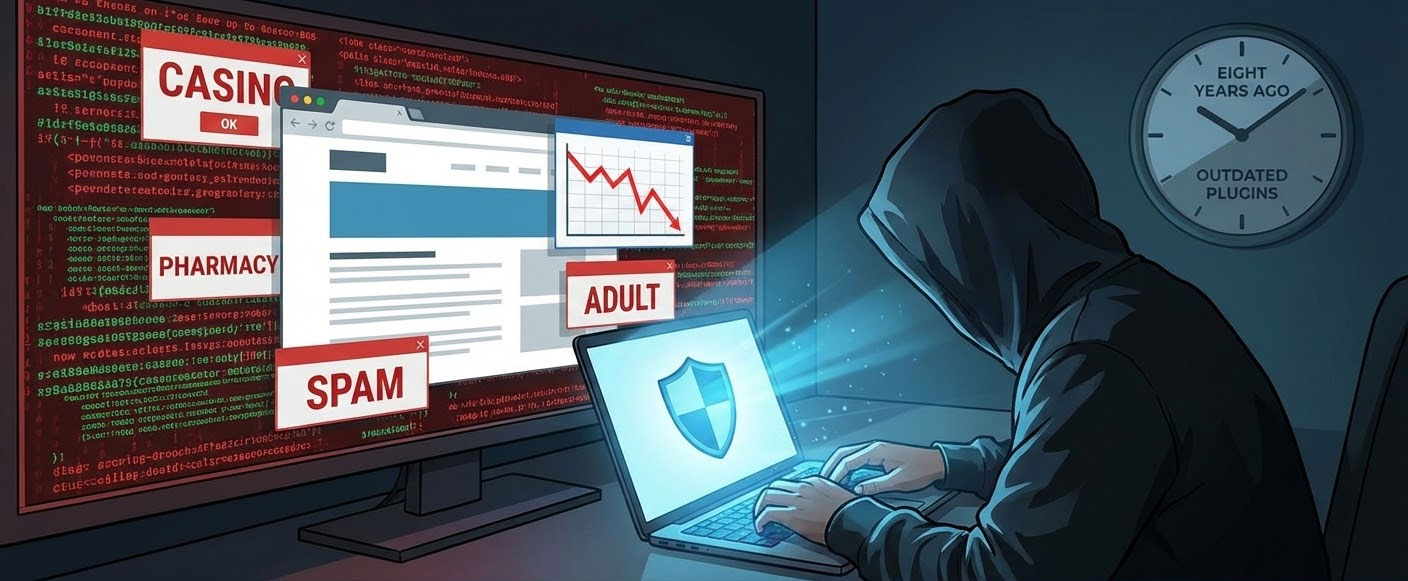
When I first registered five12.co.uk around eight years ago, it was a side project alongside my main role as an IT Manager and Software Developer. Over time, work took over, the website was neglected, and eventually it was compromised through outdated plugins.
What followed was not a normal website hack. It turned into a full SEO spam event that left the domain with a toxic backlink profile, hundreds of thousands of spam URLs, and a level of distrust in Google that made ranking virtually impossible.
What happened to the domain
After the site was left unmaintained for too long, outdated plugins created an opening for attackers. Instead of a visible homepage defacement, the hack took the form of automated spam page generation. The domain was flooded with low-quality pages targeting terms such as gambling, roulette, fake products, adult topics, pharmaceuticals, and other junk search phrases.
| Issue | Approximate scale |
|---|---|
| Indexed spam pages | ~180,000 to 400,000 |
| Not indexed / discovered spam pages | ~300,000+ |
| Legitimate pages on the actual site | ~20 |
| Incoming spam backlinks | ~20,000 |
Why this type of hack is so damaging
The biggest long-term problem was not just the hacked content itself. It was the loss of trust. Even after the old site was completely removed and replaced with a clean, secure rebuild, Google still associated the domain with years of spam behaviour.
There was no manual action in Search Console, and the domain was not de-indexed, but it was effectively suppressed. New pages would not rank for meaningful terms at all. The site would only show for extremely specific branded searches such as Five12 Digital Marketing Rosyth.
- No manual penalty shown in Google Search Console
- No complete de-indexing of the domain
- New site technically clean and rebuilt properly
- Still almost impossible to rank for normal search terms
- Strong signs that the domain was in a very low-trust state
The recovery approach
If this had been a normal client project with no attachment to the domain, the easiest answer would probably have been to buy a fresh domain and start again. In most cases, that is the most practical route.
I decided to do the opposite. I wanted to see whether a badly damaged domain could be nursed back to health, and how long that process would actually take in the real world.
Wipe the old environment completely
The old site and server setup were effectively nuked from orbit. The website was rebuilt cleanly on a fresh stack with up-to-date software, current plugins, and proper maintenance in place.
Remove redirect-style rules that signalled “content moved”
Some of the legacy blocking behaviour was returning a moved response to Google. That is not ideal in this situation, because it can suggest the content has simply relocated rather than disappeared. Those rules were removed so the spam URLs could die properly instead of being treated like redirected content.
Block crawling of obvious spam patterns in robots.txt
Robots.txt was used to discourage further crawling of known spam URL patterns while the wider clean-up was underway. This was part of the containment strategy, not the whole solution.
Disavow the toxic backlink profile
A large disavow file was built and submitted, with the vast majority of bad links disavowed at domain level. In total, this was roughly 20,000 referring domains.
Rebuild trust with a real site and consistent signals
Once the technical clean-up was underway, the focus shifted to publishing a legitimate, well-structured business website again. That included content rewrites, local SEO improvements, trusted directory links, and a consistent pattern of quality updates.
Example robots.txt block
This is the sort of pattern-based robots.txt approach used to reduce crawling of obvious spam sections. It is shown here as a simplified example only.
User-agent: *
Disallow: /roulette
Disallow: /casino
Disallow: /pharmacy
Disallow: /tag/
Disallow: /author/
Disallow: /wp-content/uploads/spam/
Important note: robots.txt does not remove URLs from Google on its own. It was only one part of the wider recovery process.
What the recovery looked like over time
I started the recovery work at the beginning of September 2025. The reductions in spam pages were not steady day by day. Instead, Google seemed to process large chunks at roughly the same point each month, followed by smaller drops in between.
| Phase | What happened |
|---|---|
| Month 1 | Clean rebuild in place, but no meaningful rankings for new pages |
| Months 2 to 4 | Large monthly drops in discovered/not indexed counts, plus smaller declines throughout the month |
| Months 4 to 6 | Trust slowly began to improve and quality pages started to get more traction |
| After roughly 6 months | Domain returned to page one visibility for competitive local web design searches |
The biggest lesson was simple: you can clean the site in a day, but you cannot force Google to forget years of spam overnight.
What finally helped bring the domain back
- Completely replacing the compromised site and environment
- Removing old rules that returned moved responses for spam URLs
- Using robots.txt to reduce crawling of obvious spam patterns
- Submitting a large-scale disavow file
- Rewriting and improving the real website content
- Building trust with legitimate local citations and directories
- Staying consistent and waiting for Google to process the history
The result
After months of clean-up, content work, and patience, the Five12 domain recovered. It is now back on page one for competitive local terms such as web design Fife, which is exactly the sort of space where many competing businesses also understand SEO.
That matters because it proves something useful for real-world consultancy. A badly damaged domain can recover, but it takes more than just removing hacked files. It takes technical clean-up, trust rebuilding, and time.
What I would tell a client in the same position
In many cases, start fresh
If the domain has no meaningful value, buying a new one is often the most cost-effective answer. It avoids months of uncertainty and gives you a clean slate immediately.
If the domain matters, recovery is possible
If the domain has brand value, history, or strategic importance, recovery can absolutely be worth attempting. The key is setting realistic expectations around timescales.
The key takeaway
This project gave me something more useful than theory. It gave me evidence. I now know from direct experience how long this sort of recovery can take, what helps, what does not, and why patience matters.
If you are dealing with a hacked domain, an SEO spam history, or a site that has lost Google trust after years of neglect, the process can be fixed, but it has to be approached properly.
